

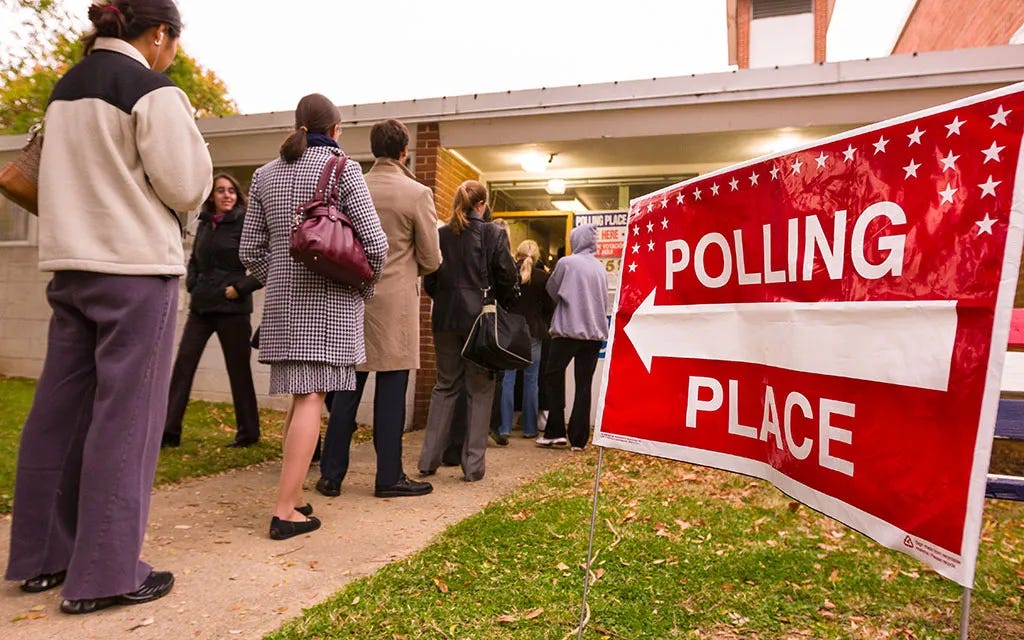
Democracy requires faith, the belief that the system will eventually self-correct, no matter how badly it seems to be veering off course. This election showed us how it’s supposed to work. After years of half-measures and often muddled responses, the nation spoke clearly, rejecting the budding authoritarianism and autocracy that seemed to be taking root across the country.
Republicans will claim that the election was a response to gas prices and the war in Iran. It was far more than that. People might not have liked the rising prices and endless wars, but they also rejected the reactionary populism that’s been the guiding light of the GOP under the spell of Donald Trump: the blatant corruption, the brutal immigration tactics, and the whitewashing of the armed forces.
African Americans came out in droves after the Supreme Court gutted the Voting Rights Act and Pete Hegseth fired many of the nation’s top Black military leaders and erased the accomplishments of African American heroes. Hispanic voters who were trending toward Republicans rebuked policies that terrorized their communities and ripped apart families. People of all colors and persuasions recoiled at a president and his family getting rich off the presidency.
For ten years, I’ve been trying to convince myself that eventually the country, and my state, would wake up. At times, I’ve despaired, believing that we were sinking into a morass of corruption, intolerance, and incompetence. Never, though, was I willing to give up the fight.
I tried to take a long view because I realized that the forces of reaction that took over the Republican Party have been with us for most of our history—and have always eventually been beaten back. At times, they’ve seemed to hold sway over the country.
They were anti-immigrant Know-Nothings who were an electoral force before the Civil War. They were the Red Shirts, the paramilitary wing of the North Carolina Democratic Party, who overthrew the elected government of Wilmington at the turn of the 20th century. They were the white supremacist politicians who stripped African Americans of the right to vote and implemented Jim Crow. They were the Ku Klux Klan of the 1920s who terrorized African Americans, Jews, and Catholics to maintain an unjust social order. They were the segregationists of the Civil Rights era who demanded, as George Wallace declared, “Segregation now, segregation tomorrow, segregation forever!”
Each version of these reactionary populists shared the traits we’ve seen in MAGA—the rejection of immigrants, the othering of non-white people, a disdain for democracy, and an embrace of authoritarian tactics. They were all eventually beaten back, but in the South, it took almost 65 years to defeat them in the 20th century. Fifty years later, Trump animated them and gave them power again.
I was ready for the long fight. After the midterms, I think it will be a much shorter battle. It’s not over yet, but the people delivered the reactionaries a stunning blow this year.
In North Carolina, the victory was stronger than in most places. Democrats flipped the state House and almost flipped the state Senate. They turned the Congressional delegation upside down, giving Democrats an 11-3 advantage instead of the expected 11-3 deficit. They elected Roy Cooper by the largest margin of any senator in more than 50 years, and they re-elected Anita Earls and kept the three judges on the Court of Appeals.
Republicans in the state have done little to earn the trust or respect of voters. Instead of listening to people, they’ve focused on consolidating their power. They stripped power from the governor after Josh Stein won a decisive victory and redistricted in the middle of the decade in a blatant attempt to rig a Congressional district. Meanwhile, they went almost three years without passing a budget, leaving state employees’ pay stagnant while prices rose.
In contrast, North Carolina Democrats fought back. The popular Governor Josh Stein barnstormed the state for legislative candidates and helped them raise the money to win. Grassroots organizations in rural areas and big cities motivated voters across the state. State party Chair Anderson Clayton turned the party into a campaign operation instead of a social club, recruiting candidates to fill most of the ballots and giving every county and precinct marching orders.
After a decade of stress tests by a corrupted Republican Party, democracy worked. The system is battered and the experience laid bare the weak points, but the people rejected the authoritarians and rogues who make up MAGA.
That doesn’t mean the threats weren’t real. For ten years, the country was heading down a dangerous path. Some conservatives saw it and paid a price for saying so. Others insisted it was just politics as usual, or looked away because the power was too good to give up. We came closer to losing our democracy than most people want to admit.
The past decade showed us the cracks in the system. The first is a Washington that grew out of touch with the people it serves. This election went a long way toward solving that problem. Roy Cooper is the exception, a familiar name voters trusted. Most of the rest of the incoming class came out of their communities, not the political class. James Talarico taught middle school before he went to the Texas House. Troy Jackson worked as a logger in northern Maine. Annie Andrews is a pediatrician, and Scott Colom is a prosecutor.
The North Carolina delegation exemplifies the fresh perspectives heading to Washington. We’re sending a farmer, two veterans, a retired journalist, a businessman, a mayor, and a minister who experienced homelessness.
The second crack is harder to fix. Billionaires and corporations have bought too much access to power. Trump didn’t create that problem, but he exploited it, running against a rigged system and then rigging it further for himself, his family, and his friends.
Washington has a way of turning outsiders into insiders. If this new class is going to stay rooted in their communities, they’ll need to change the system that pulls them away. After Watergate, Congress passed a wave of reforms to curb corruption and the abuse of power. Over the next half century, many of them were weakened or dismantled. Now we need a new round to address the distorted influence of billionaires and corporations over our political system. Shine a light on dark money. Ban members of Congress from trading stocks. Slow the revolving door between Capitol Hill and K Street.
The third crack is a power structure out of balance. The founders feared demagogues and built checks to restrain them, but Congress has given too much of its power away. Rein in the pardon power. Take back authority over tariffs and emergency declarations. Protect the inspectors general and election officials who stood in the way of overreach. End partisan gerrymandering, because competition keeps politicians honest. The same lesson applies in Raleigh, where Republicans rewrote the rules every time voters didn’t give them what they wanted.
There’s still work to be done. The forces of reaction never go away quietly. We’ve beaten them back before, from the Know-Nothings to Wilmington to Jim Crow. Last century, in the South, it took almost 65 years, and it took the Civil Rights Act of 1964 and the Voting Rights Act of 1965 to reset the social and political dynamic in our country. This time it’s been ten years—so far. If Democrats use this moment well, they can send MAGA back under the rock it crawled out of and protect our democracy from the next demagogue or would-be dictator.
Democracy requires faith. It also requires maintenance.
Well said, Thomas. A couple of reforms worth pursuing:
If there's enough oxygen for it, a constitutional amendment limiting the pardon power could be enacted before the next presidential election. A president can't veto those as they go through the process. (One probably wouldn't apply to Trump, sadly, because such things do take time.)
Congress could pass legislation ending partisan gerrymandering, too, and dare Trump to veto it. It's a great issue to run on in ‘28 if he does.
Both are doable, they don't necessarily benefit one party over another, and you have to start somewhere.
I am so proud of our state. Republicans thought they controlled everything, but the people showed them the truth. Now it’s time for Democrats (state and federal) to get to work and do the things that need to be done and not fall back into the old ways of trying to appease and court the right-wing reactionaries and corporate overlords.