

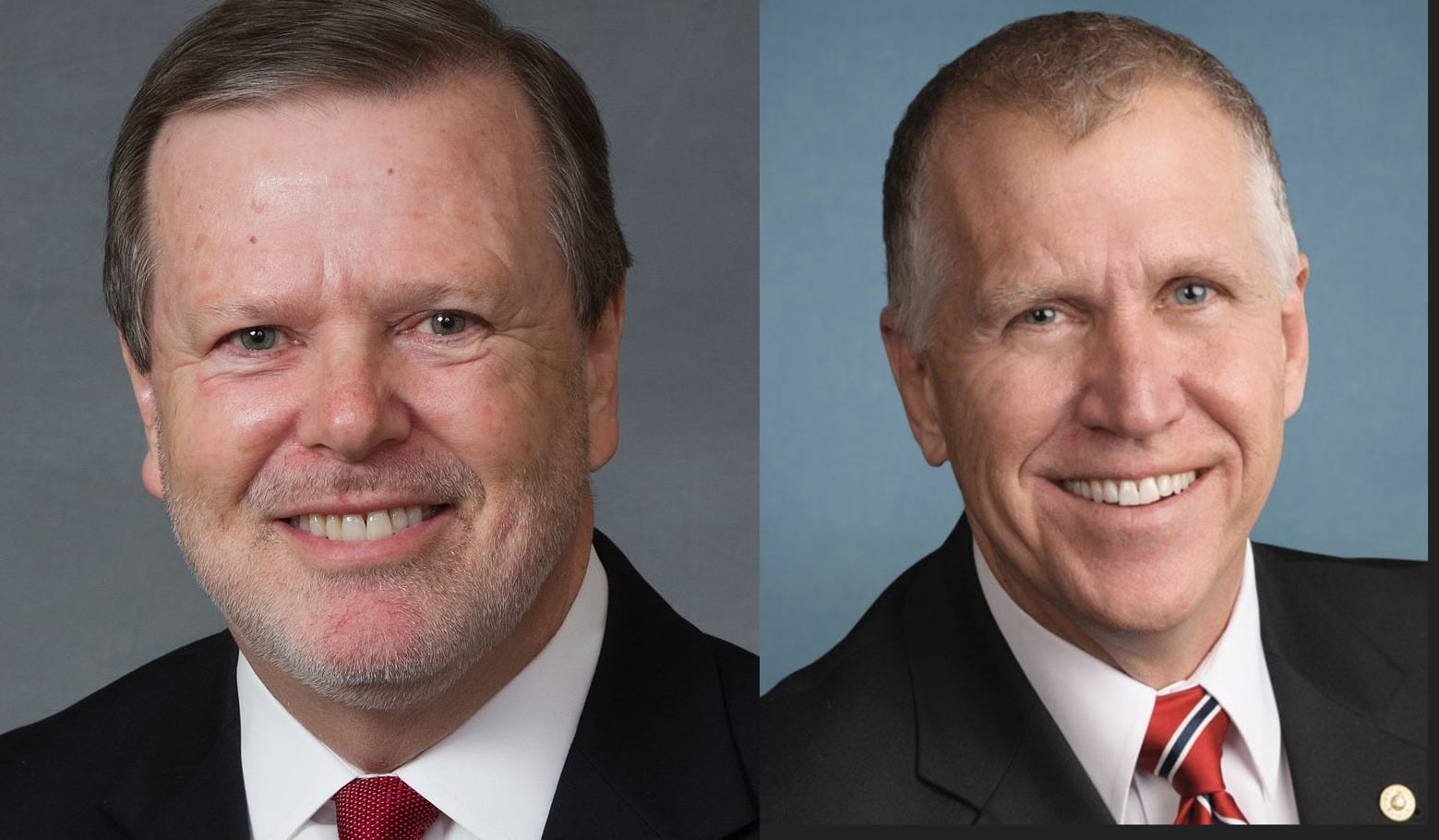
In January 2011, State Senator Phil Berger and then-State Representative Thom Tillis entered the North Carolina political stage at the same time. As Republicans took control of the legislature for the first time in more than a hundred years, they led their respective chambers. If Berger loses his primary, they will exit at the same time.
They were very different leaders then and they still are. Berger had sat quietly in the back row of the Senate, watching his predecessor, Marc Basnight, competently lead Senate Democrats for years before he took the reins. Thom Tillis was only beginning his third term when he skipped the line to become speaker of a rowdy Republican caucus that would become even rowdier in years to come.
Berger seems introverted and reflective, mostly shying from the press except for planned interviews or press availabilities. Tillis is gregarious, often bantering with reporters in hallways. Berger rarely needs to make retractions. Tillis’s mouth occasionally lands him in the news.
Together, Tillis and Berger steered North Carolina hard to the right in the early days of the state’s version of the Republican revolution. At first, they seemed to be in sync. They held press conferences together and shared an agenda. They also had a Democratic governor who mitigated their most extreme instincts and gave them a common adversary.
In 2013, Pat McCrory won the governor’s office and Republicans gained complete control of both the legislature and executive branch for the first time in more than a century. Cracks in the unity emerged as both Berger and Tillis were considered as potential candidates to challenge Democratic U.S. Senator Kay Hagan in 2014. The two men also had conflicting legislative priorities.
Tillis and McCrory were both from Charlotte and moderate, business-friendly Republicans more interested in cutting taxes and regulations than taking on social issues. Berger was a small-town lawyer from rural Rockingham County and more of a hardliner. When Tillis and McCrory started making plans to set up a state insurance exchange and expand Medicaid under the newly enacted Affordable Care Act, Berger killed the move and opposition to Medicaid expansion became the GOP party line for another decade.
Berger ran a tight caucus operation that looked a lot like the one Basnight ran. Members didn’t leak and generally stayed in line. Ambitions were kept in check, though senators must have felt they had enough say or there would have been more grumbling.
Tillis oversaw a rowdy bunch of house members who proposed crazy legislation like a state religion and withdrawing from the Federal Reserve. Members spoke freely to the press, often garnering embarrassing headlines. Before he was halfway through his second term as Speaker, Tillis was running for U.S. Senate.
Berger emerged as the most powerful man in the state, outflanking the hapless Governor McCrory, who spent four years unsuccessfully trying to figure out how Raleigh worked. Tillis became the luckiest politician in the country, narrowly beating Hagan when ISIS and Ebola tanked the political environment in October 2014. Six years later, he looked poised to lose his seat when his opponent got caught with his cyber pants down in October of 2020.
Tillis never really figured out how to navigate Trump’s Republican Party. He wasn’t MAGA but he spent a lot of time pandering to them or to Trump. Instead of currying favor, he just looked insincere. Trump obviously didn’t trust him and the base could sense it.
Tillis’s views of the world never really changed. He’s still the business-friendly Republican who went to Raleigh from the suburbs of Charlotte. In other words, he’s part of a dying breed — or at least one in serious decline.
As I’ve said repeatedly, he knows what’s right, but often does what’s wrong. Every time, he’s betraying his better instincts to pander. He knew people like Kristi Noem, Pete Hegseth, Kash Patel, and RFK, Jr., have no business anywhere near the levers of power, but he lacked the courage of his convictions to vote against them. Of course, he was still worried about a primary back then. He’s like Louisiana Senator John Kennedy without the political skills.
Berger, for his part, morphed into the MAGA world a bit more easily. Berger probably does have less respect for the democratic norms that Tillis still respects, but he also knows better. He embraced Trump and endorsed Mark Robinson knowing full well the guy was unqualified to get anywhere near the Governor’s Mansion. His capitulation to Trumpism was disappointing and, really, beneath him, but power is intoxicating and getting on the wrong side of the base would have complicated his political life.
Berger is the fish that outgrew his pond. He may have been the most powerful Republican in the state, but he was still beholden to the voters of a provincial rural district. He lost touch with the people back home and should have read the writing on the wall.
Berger would have been smarter to have retired with the changing of the guard that brought in a new governor and new council of state. Instead, he’ll either lose in a humiliating manner after spending more than $10 million to try to hold his seat, or win in a race that will forever be suspect to the voters who see him trailing after votes have been counted. It’s an inauspicious ending for a politician who has climbed so high.
Tillis, for his part, seems like he’s auditioning for a second act. He’s all over cable news, speaking his mind. He sounds sincere finally, but if he is, it brings into question his record of flip-flops and pandering. He may find a place on Fox News or some podcast while he lobbies and becomes a gazillionaire, but I have doubts about a future political career.
Tillis can leave the political stage with some impressive bipartisan legislative accomplishments. He also survived twelve years in a chaotic GOP political transformation that ended the careers of like-minded colleagues like Arizona Senator Jeff Flake and Tennessee Senator Bob Corker. Eventually, though, he fell victim to MAGA. He decided not to run because he lost the trust of the conspiracy-minded authoritarians in his own party.
I was never going to agree with either Phil Berger or Thom Tillis politically, but I wanted to find some common ground for the good of the state that I love.
In the beginning, I respected Berger for the way he ran his caucus and for his humility. In 2013, when Moral Mondays were roiling the state, he invited William Barber to meet in his office, saying the protesters’ concerns deserved to be heard. Maybe it was an insincere political move, but it’s what leaders should do. I doubt that would happen today.
With Tillis, I could respect his desire to make government work through compromise and bipartisanship. I couldn’t take his habit of saying one thing and doing another. I detested watching him pander to the worst instincts of his party for political gain. At a time when his party needed people with political courage to stand up, he was always just a little too late. Berating Kristi Noem last week in the Senate may have been good theater, but keeping her away from the position she left in the first place would have been the right thing for the country. He knew better, but lacked the courage of his convictions.
As both men leave the state stage, the biggest threats to the country are not the taxes and regulations that were the focus when they took power in 2011, but an anti-democratic reactionary movement that has taken root deep in their party. Neither man stood up to it, though Tillis tried more than Berger. Both leave with legacies of accomplishments, for better or worse, that transformed North Carolina.
I wish them well in retirement, but I can’t say I hate to see them go.
Maybe NC is emerging from a 15-year nightmare. I lived through the Jesse Helms era. There is a nut base that won’t go away.
Well put Berger: A fish that got too big for its pond