

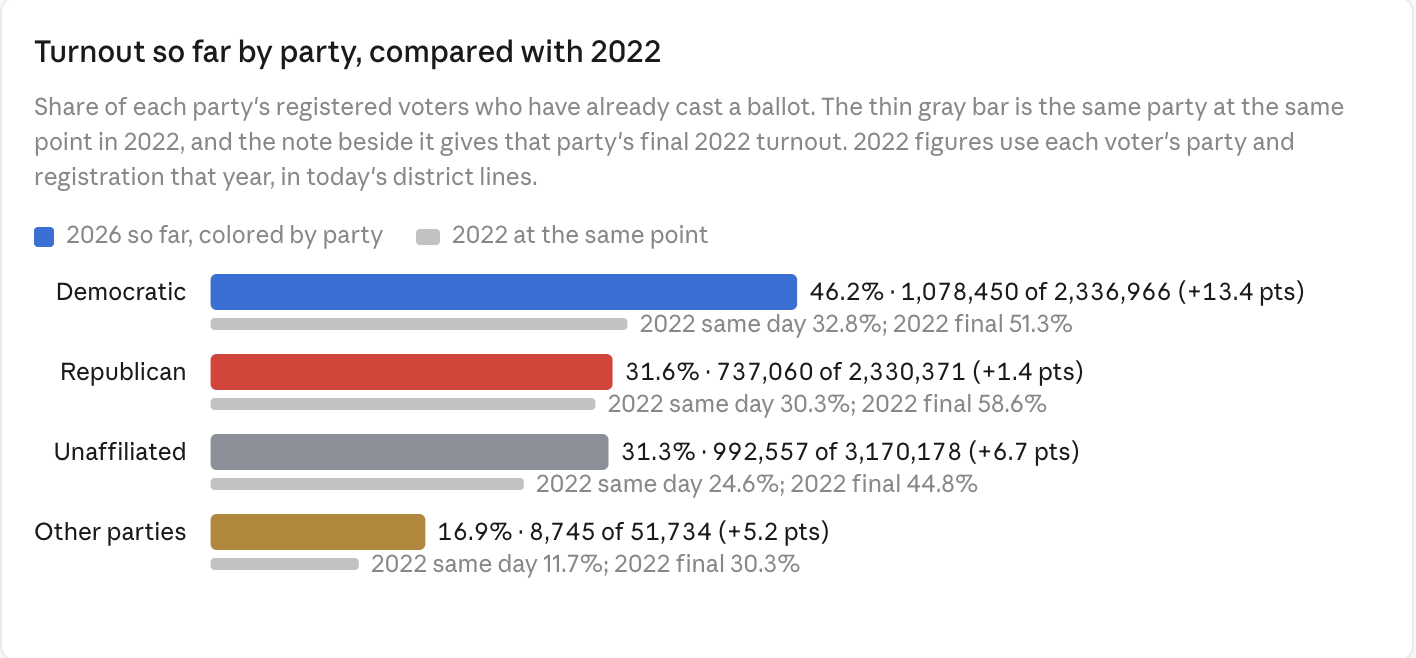
Early voting is over, and we’re getting a much clearer picture of what’s happening in this election. Democrats and unaffiliated voters are surging, while Republicans are keeping pace with previous midterms. Democrats cast 38.3% of early ballots, Republicans 26.2% and unaffiliated voters 35.2%.
In raw numbers, 1,078,450 Democrats have voted, along with 737,060 Republicans and 992,557 unaffiliated voters. (To toot my own horn: last Thursday, I predicted 730,000 Republican votes, 1 million unaffiliated votes and between 1,050,000 and 1,130,000 Democratic votes. I was pretty close.) Democrats go into Election Day with 341,390 more votes than Republicans. Unaffiliated voters are the great unknown, but every poll I’ve seen says they are breaking for Democrats, and in a big way.
Republicans will probably add another 620,000 or so voters. Republicans are consistent. Year after year, they follow the same pattern, so estimating their vote has been easy. I’m fairly confident that about 1,360,000 Republicans will vote this year.
Republicans have a built-in advantage in wave years: their voters still show up. When Republicans won historic victories in 2010 and 1994, Democratic turnout collapsed. There’s no evidence of that this year, and it didn’t happen in 2018. Republicans’ high floor gives them a measure of protection that Democrats don’t have.
Democrats will likely add another 350,000 or so. If they turn out more low-propensity voters, that number could go up, but I don’t think it will go down much. Even at 350,000, Democrats would still lead by about 68,000 votes if there’s no crossover voting.
Unaffiliated voters will widen the Democratic margin. They’re voting at a considerably higher rate than in past elections. Their surge exceeds the Democrats’ surge, while Republicans are seeing almost no surge at all. Another 600,000 or so unaffiliated voters will vote on Election Day.
I expect unaffiliated voters to break for Democrats by 13 to 16 points. Gary Pearce’s poll from late September showed unaffiliated voters favoring Roy Cooper over Michael Whatley by 15 points and preferring Democrats on the generic legislative ballot by about 13 points. A Harper Polling survey for Carolina Journal has Democrats leading the generic ballot among independents by about 11 points. A Quantus Insights poll from last week shows Cooper leading among unaffiliated voters by 19 points.
Put all those numbers together and Cooper wins handily. If voters in both parties vote a straight party line and unaffiliated voters break by 13 to 16 points for Democrats, he wins by about seven points. That assumes no crossover, and the Quantus poll shows him getting 7% of Republicans and Whatley getting 3% of Democrats. If that happens, Cooper’s lead would grow.
Anita Earls and the other judicial candidates will win by slightly smaller margins, but still relatively comfortably. The state House is a toss-up to flip. The state Senate will narrowly stay in Republican hands.
Jamie Ager will probably win NC-11 by a point or two. Don Davis has a tougher battle in eastern North Carolina. His new gerrymandered district is more Republican than it was. After a huge barrage of spending, Republicans are turning out at a higher rate there than in the rest of the state. Democrats will need either a bigger surge on Election Day or more unaffiliated voters breaking their way to put other congressional districts into play.
Here’s what could change those predictions. Republicans could surge on Election Day. That doesn’t seem likely, because low-propensity Republicans are down 7% from 2022 while low-propensity Democrats have nearly doubled. If those missing Republican low-propensity voters show up on Election Day, Republicans could make up ground, but this looks more like an enthusiasm gap.
Democrats could see a bigger surge on Election Day, but that doesn’t seem likely either. They’ve already cast 84% as many votes as they did in all of 2022. Their daily turnout slipped in the final days of early voting because fewer Democrats were left to vote.
Republicans could be doing better with unaffiliated voters than I believe. That’s probably the greatest unknown. If unaffiliated voters split evenly, Democrats will probably win by an unnervingly narrow margin. That said, unaffiliated voters are behaving more like Democrats than Republicans, voting at substantially higher levels than in the past. The ones voting later may lean more Republican, but I don’t think the surge voters are breaking for the GOP.
I believe North Carolina Democrats will have their best night since 2008, when Kay Hagan flipped a Senate seat by 8.5 points. I base that more on the early-vote numbers than on any polling. Democrats are motivated. Unaffiliated voters, who now skew heavily younger, are surging. African Americans are voting above their share of registered voters. It might be a little too early to pop the champagne, but I wouldn’t hesitate to buy the bottle.

Whew! Any insight on NC-09 between Ojeda bumping out Richard Hudson?🤞🏼
I wonder which of the "other" parties, Greens or Libertarians, voted early.....