

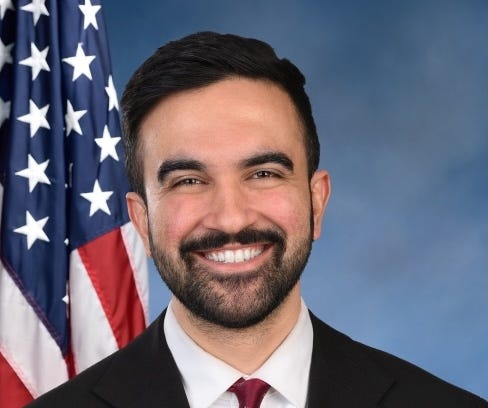
Over the past week, several readers have chastised me for not mentioning Zohran Mamdani in my election roundups, either in print or on my podcast. Mamdani ran a great race for New York mayor, but I don’t think his election has much relationship with politics in North Carolina or other swing states. Outcomes in Virginia, New Jersey, Pennsylvania, Mississippi, and municipalities across North Carolina tell us much more about the political environment nationally and where we might be headed in 2026 than the results in NYC.
New York is one of the most Democratic cities in the country, not a swing state. Mamdani defeated two very flawed candidates, including a Democrat, to win the seat. His victory was most impressive because he came from almost nowhere to become a national figure in less than a year. But he could only garner that type of attention because New York is home to the country’s national media. The city plays an outsized role in the media narrative that is not reflected in the reality of towns and cities in other states, especially those outside of the Northeast.
What Democrats can learn from Mamdani is that staying focused on an economic message is a winner. The New Yorker made affordability the central message of his campaign and he stayed on message far better than most politicians would. He also appeared everywhere, using social media and videos to amplify his presence. The world of press releases and press conferences is largely over. Tik-Toc videos and unscripted interactions rule the day. Mamdani used personal charisma, strong political instincts, and new and emerging technologies to excite younger and anti-establishment voters to become the youngest mayor of New York in more than a century.
That said, Mamdani and his embrace of Democratic Socialism would not play well in most swing states. An analysis released by the University of Virginia’s Center for Politics shows that the coalitions that propelled Abigail Spanberger of Virginia and Mikie Sherrill of New Jersey to win landslide victories in their races for governor are more expansive than the narrower coalition built by Mamdani. Spanberger and Sherrill won larger shares of moderate voters, non-white voters, and the high propensity voters over the age of 45. They also fared better among working class voters and those without college degrees. Mamdani’s coalition relied heavily on younger voters, a demographic that is both unreliable and fickle.
Anderson Clayton made the point on the podcast that Republicans have nationalized their message. Everything is about Donald Trump. Democrats, in contrast, won in diverse areas talking about local issues like housing and the price of groceries. In a big tent party, Democratic victories can reflect the diversity of the country by focusing on the concerns of local populations. They can win New York City at the same time they win in Jacksonville, NC.
On another topic, I don’t understand why people are embracing the Democratic Socialist label. The saying “leading with your chin” comes to mind. It reminds me of the slogan “Defund the police.” Democratic Socialists start the conversation by alienating a majority of the people in the country.
For people who grew up in the Cold War era, the most reliable voters in the electorate, “socialist” has negative connotations. People think of the Eastern Bloc countries that rejected socialism after the Iron Curtain fell. According to Gallup, less than 40% of Americans have favorable views of socialism.
Most people associate socialism with failed states or deeply oppressive ones. The countries that call themselves socialist are not ones we want to emulate. China, Vietnam, Laos, Venezuela, Cuba, and North Korea all embrace the label.
Most Democratic Socialists point to northern European countries as their model, but Scandinavian countries like Sweden, Norway, and Finland consider themselves capitalist, not socialist. They just have strong social safety nets.
In fact, Sweden has a higher number of billionaires per capita than the United States and has high income inequality. The country also provides free higher education, universal health care, generous family leave, worker protections, and a hefty pension. They are one of the happiest countries in the world. The Swedish Social Democratic Party “advocates for social justice, equality, and the expansion of the welfare state.” Income inequality is less of a problem when people aren’t falling through the cracks.
So my advice to the Democratic Socialists of America is drop the socialist label. Take a cue from the Europeans. Become Social Democrats instead of Democratic Socialists. The former emphasizes a commitment to democracy with an emphasis on social issues. The latter implies heavy-handed government supported by a broad coalition of voters. One label reflects a realistic American perspective. The other is an unpopular pipe dream.
The "elephant in the room" with Mamdani isn't the "socialist" label or even his policies. It's his authenticity.
Mamdani has been a community organizer and lives in Brooklyn. He rides the subway, knows the city, and is the kind of guy that average people would run into in the city.
One of the things I've noticed, on the local level, is that Republicans and many Democrats running for office aren't someone you'd run into when you go grocery shopping or see randomly at at restaurant or shopping center.
In my county, people on the town council and county commissioners have traditionally been old money "upper crust" types who have big exclusive homes, country club memberships, and aren't going to go slumming at Food Lion. And I'm talking about both Democrats and Republicans.
In this cycle, I saw the people winning seats on my local city council and on the county commissioners that were a middle class firefighter, active in the local community, a small business owner from a middle class average neighborhood, and similar candidates.
Compare this to one prominent county commissioner from a few years ago whose husband operates a charter airline and comes from a prominent, very rich, Republican-connected family. You never saw her around town where "normal" people go. Now, she's in the state legislature.
My point is that the Democrats need to get better at recruiting and supporting competent candidates with a background centered in communities. Sure, the lawyers and business types might be good at schmoozing for bucks among the local and state Hoi polloi, but they just can't speak to voters in a way that really shows empathy and a sense of understanding their problems.
We need more people like Tim Walz who doesn't wince and look like he's sucking lemons when he talks about the struggles of minorities or LGBTQ people because, as a teacher and coach, he dealt with the problems of a wide range of people every day. You don't get that kind of perspective working as a corporate lawyer or sitting in some boardroom every day.
I certainly agree that Dems need to be careful about using Mamdani as model everywhere, but think you push back a bit too hard on that. As you point out, his laser like focus on affordability is a winning strategy everywhere. Also, seems odd to point out that Sherrill and Spanberger did better among moderate voters than Mamdani did. To the best of my knowledge, they weren't running against two candidates to his right and one (the most famous Dem in NYS and absurdly well funded) was running for "moderate vote." On socialism thing, that is correct stat on most Americans not having positive view of it. That is not the case among Dems. "A new Gallup poll finds that while U.S. adults overall are more likely to have a positive view of capitalism than socialism, Democrats feel differently. According to the survey, only 42% of Democrats view capitalism favorably, while 66% have a positive view of socialism."