

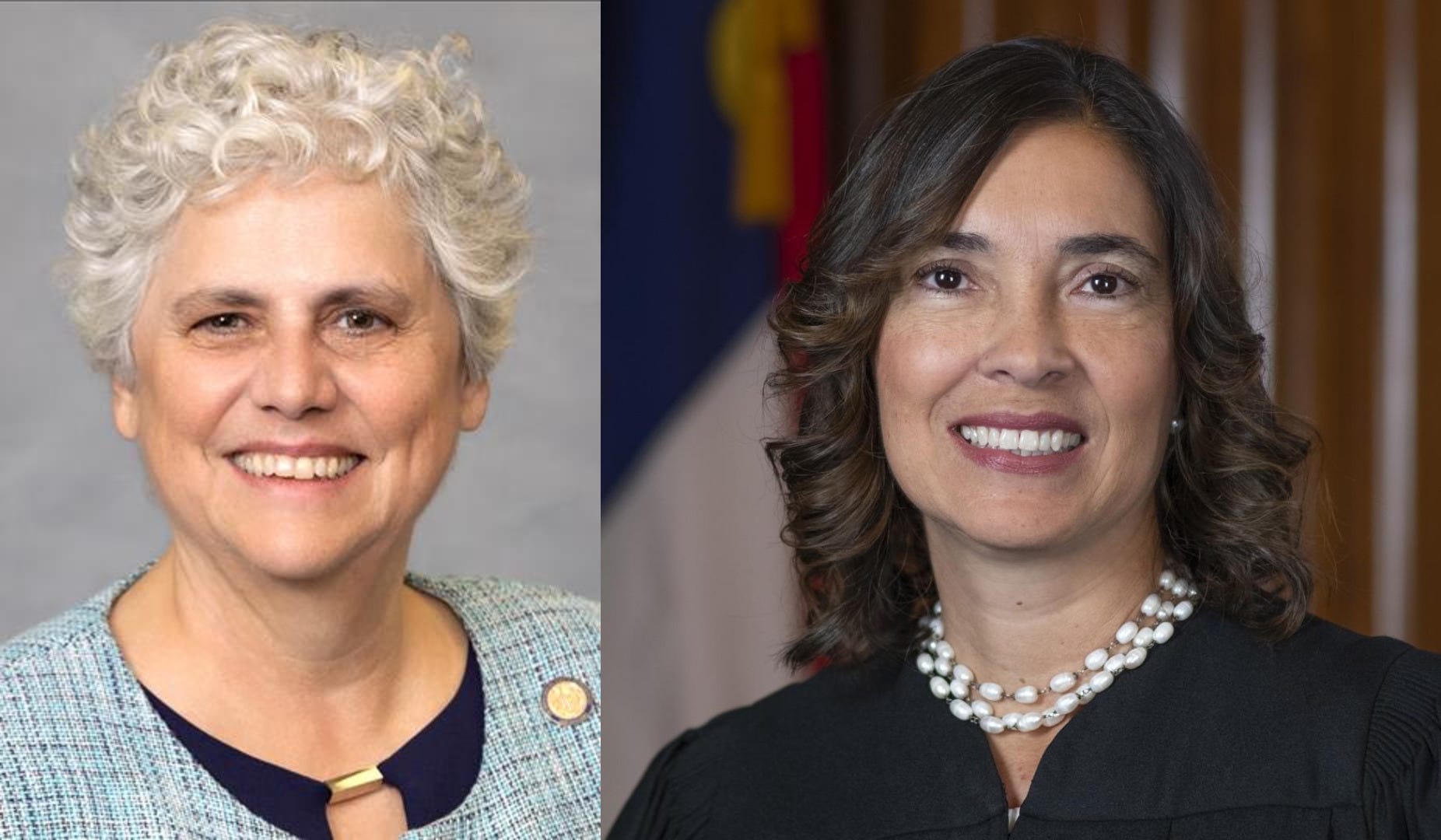
The most important race on the ballot in North Carolina is, arguably, for Supreme Court. Justice Anita Earls is trying to hold the seat she won eight years ago. Former Republican state representative Sarah Stevens wants to unseat her. Earls is one of only two Democrats on the court and needs to hold the seat to give Democrats a decent shot at gaining a majority before the end of the decade.
In a forum this week, Stevens said that her judicial heroes were Paul Newby, chief justice of the Supreme Court of North Carolina, and John Roberts, chief justice of the U.S. Supreme Court. That answer alone should disqualify her. She could have said Sandra Day O’Connor, the first woman to serve on the Supreme Court and a conservative. She could have said Antonin Scalia, a conservative judicial giant. Or she could have mentioned Susie Sharp, the first woman to serve as chief justice of the Supreme Court of North Carolina. Instead, she chose two men who will be most noted for politicizing their courts.
Newby, in particular, is a petty man who repeatedly puts politics ahead of jurisprudence. He whined when then-Governor Roy Cooper appointed Cheri Beasley to the chief justice position instead of him. When Republicans took control of the court, he scrapped the concept of judicial precedent to make nakedly partisan decisions on gerrymandering and voting restrictions. He tried to change the rules of an election after it was over, until he was slapped down by a Trump-appointed federal judge. And he removed senior judges at the Court of Appeals, superior court, and district court from administrative duties if they were not sufficiently conservative or loyal to him or the GOP.
North Carolina has never seen a more activist judge than Paul Newby. His court often behaves more like a legislative body than a judicial one. He has made judicial review subservient to legislative action, ruling consistently in favor of the General Assembly instead of providing checks and balances.
Newby has forgotten North Carolina’s judicial legacy. In 1787, in the case of Bayard v. Singleton, a North Carolina court was the first in the nation to find a legislative act unconstitutional. It set the precedent for Marbury v. Madison, which established judicial review as a core function of the court system. Newby’s court has been little more than a rubber stamp for Republican legislative and political desires.
Anybody who cites Newby as a judicial hero has no business anywhere near the Supreme Court. Stevens has signaled she would take her partisanship to the state’s highest court to protect the GOP’s legislative agenda. We don’t need more hacks than we already have.
In contrast, Earls has been an outstanding jurist. She has a judicial philosophy with deep historical roots that guides her decisions. She believes strongly in civil rights, equality, and the court as part of a system of checks and balances. She also understands the administrative role the court plays. She’s clearly the better candidate, both for the seat and for the state.
Sarah Stevens brings little to the court that it doesn’t already have. She’s indicated she would be beholden to a hyper-partisan chief justice, and her experience is more political than judicial. We need thoughtful justices who will add the accountability that’s sorely lacking.
Anita Earls will provide the oversight and checks our system demands.

Thomas, that is a great comparison with specifics to tell people who are undecided.
However, equally important to re-electing Justice Anita Earls is to elect the three Democrats running for Court of Appeals - John Arrowood, Toby Hampson, and Christine Walczak. Most cases do not go further than the Court of Appeals. There are currently only three Democrats on the Court of Appeals and all three seats are up for election this year. All three candidates are amazing. Arrowood and Hampson are incumbents and Walczak has been a Superior Court judge for 19 years.
You are so right. Thank you for writing about the NC Supreme Court race.