

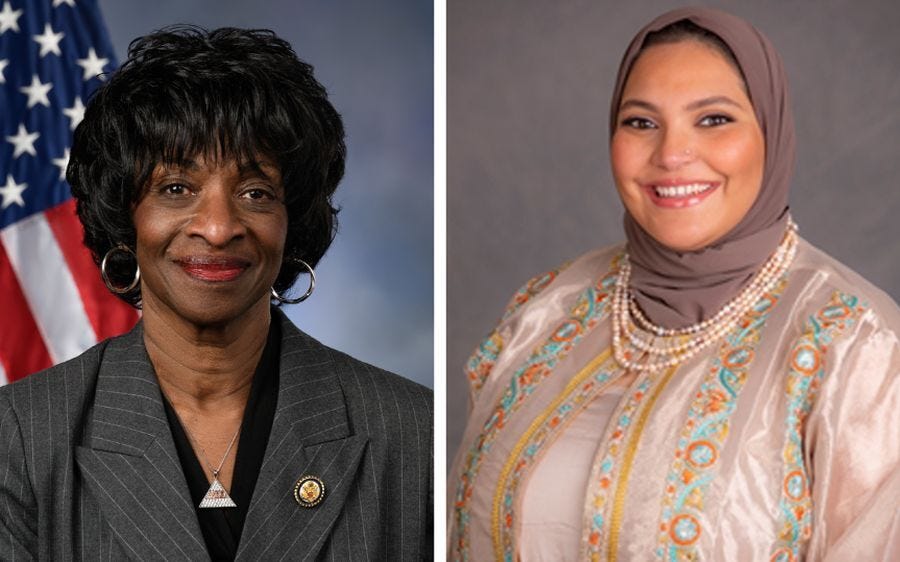
There’s a primary playing out in my back yard that has implications for Democrats in North Carolina and nationally. Durham County Commissioner Nida Allam is challenging incumbent Congresswoman Valerie Foushee in a district that includes all of Orange and Durham Counties and parts of Wake and Chatham. Allam is the face of an emerging Democratic Party and Foushee comes from the traditional one. The primary highlights the generational divide roiling the Democratic Party.
Allam is the first Muslim woman elected to office in North Carolina. She grew up in the area, attended public schools here, and graduated from NC State, but was born in Canada. She’s endorsed by Senator Bernie Sanders and a host of progressive organizations and politicians as well as by many of her colleagues on the Durham County Commission. At 32 years old, she’s part of a new generation of progressive leaders reshaping the Democratic Party.
Foushee comes from the more traditional wing of the party. She has deep roots in the area that go back generations. She spent years in the state legislature before going to Washington. Instead of pushing an ideological agenda, she’s worked to get results. She’s never been flashy or controversial, but she’s always been respected by her colleagues.
Reading their policy pages, the two leaders hold similar views. Both support Medicare for All. Both support a Green New Deal. Both are strongly pro-choice. And both oppose Trump’s immigration policies.
The difference comes mainly in tone. Allam sees her campaign as part of a movement. She’s part of a younger generation of progressives that wants to push an agenda centered on fairness and equality with an emphasis on addressing what they see as an unjust system.
Foushee centers her positions on solutions, more than ideology. While she uses the same progressive language, she does not lead with it. She sees herself as a problem solver instead of an ideological warrior.
Both lean heavily into their bios to attract supporters. Allam talks about her parents coming to the Triangle to find a better life and her commitment to building one for herself and her young family. Foushee emphasizes her generational connection to the area, focusing on overcoming the struggles of racial discrimination in the post-Civil Rights South.
Allam is appealing to the newcomers to the Triangle. Durham is a place on the move, attracting educated, innovative, creative types to its new downtown. She’s been part of the transformation and her base voters are people who have arrived here in the past 25 years.
Foushee is part of the Democratic Party that was more working class and rural. She’s appealing to older, more moderate voters, both Black and white, who know that change comes with unintended consequences. Her base is the shrinking group of people who have been here for more than just a generation.
The race will probably come down to whether or not Foushee can hold the African American voters in Durham County. Orange County will probably stick with her since she has been a reliable leader for many years. She should win Chatham, which she represented in the state Senate. I don’t know how Wake will break, but it could be the deciding county if one candidate can consolidate the vote.
I think the Democratic Party needs to embrace a new generation of leaders, but they also need the wisdom of experience. I wish Allam sounded a little more pragmatic and a little less ideological. I don’t want to be part of a movement, hers or anybody else’s. I just want government to function.
Foushee came of age in a contentious time when the South was in transition. She’s lived through what it takes to not just beat the populists, but to bring other people along. Governing requires compromise and flexibility, traits Foushee has shown throughout her career.
I will probably be relatively satisfied with either woman representing me in Congress. If Allam wins, I hope she will stand up for more than just immigrant and minority groups who have transformed Durham. I hope she will also reach out to the people who have lost their cultural foundations because of those changes.
If Foushee wins, I hope she will be mindful of the generational shift taking place within the party and country. In the coming years, her generation and mine will need to make way for new voices to lead us into drastically changing world.
Jane and I hosted a fundraiser for Valerie yesterday, our third. More than 70 people showed up in the rain, it was a successful event.
I agree with your characterization of the candidates. In some cases, I might favor the firebrand. But I would not do that at the expense of operational effectiveness.
We have more than enough real work to do, and I regret that this 4th district race is sucking up resources that could be deployed in other places, places where the choice is not between two good Democrats, but between good Democrats and fascist Republicans.
Our problem in Congress is not that we need more vocal progressive representation. We simply need more Democrats.
I am not entirely opposed to Foushee, but I have two points of concern. First, she has accepted money from AIPAC, which is one of the major protectors of Israel and its dangerous, misguided and counterproductive campaign against Palestine. It is heart-breaking for someone that loved reading Leon Uris, but that campaign can no longer be distinguished from genocide. Second, Foushee is a co-chair of the “Innovation Agenda” which fails entirely to take aim at the structures and policies of neoliberalism which have destroyed the working class and the soul of the Democratic Party. There is nothing - NOTHING - in the “Innovation Agenda” about taking on Wall Street and the banksters and ending the market dictatorship of financialization. As Matt Stoller summarized it, "this agenda is about lowering financing costs for powerful firms and subsidizing Wall Street-style financialization and offshoring."