

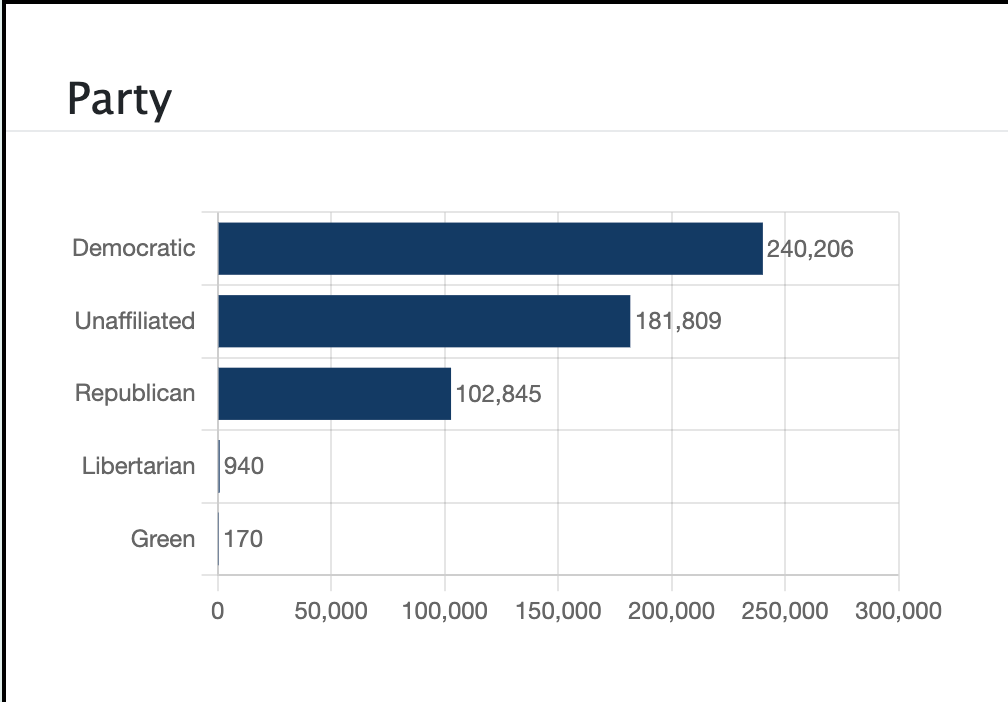
We now have competing online vote trackers for North Carolina. For years, Civitas has had a tool to track early voting. Now, Carolina Forward has one. I’ve relied on the Civitas tracker for years, but I think it will need an update if it wants to compete.
The two trackers mostly have the same information, but the Carolina Forward one is more user-friendly, with an updated interface that makes the Civitas tracker feel clunky and a little outdated. The new tracker also offers easy comparisons with previous years and readily surfaces information about vote propensity and demographics. Much of that information is available on Civitas, but it takes some searching.
Civitas has one advantage that I can’t find on the Carolina Forward tracker: more history. While Carolina Forward offers comparisons to the last two general elections, Civitas goes back to the 2000 cycle. I’m as interested in the turnout in 2018 as I am in the 2022 turnout. I use Civitas for that.
That said, most of what I’m looking for is more easily accessible on the Carolina Forward tracker. I’m grateful to both organizations for providing the information. I hope the competition makes them better tools. The more information, and the easier it is to access, the better.
In using these tools, I’ve had a lot of fun watching the votes come in. While it’s still very early, some trends are starting to develop, and they bode well for Democrats. First, turnout so far is high. Far more people have voted this year than in either 2022 or 2018. More than 525,000 people had voted through Sunday. During the same four-day period in 2022, only 383,000 had voted, and in 2018, only 426,000 had.
Democrats are dominating the voting. They make up about 46% of the voters, more than the 41% in 2022 or 43% in 2018. Republicans make up only 20% of the vote, instead of the 29% in 2022 or the 30% in 2018. Unaffiliated voters are making their presence felt. They make up about 35% of the voters, as opposed to 30% in 2022 and 26% in 2018.
Probably the best news for Democrats is the turnout among African American voters. They make up 23% of the voters, and made up only 19% at this point in both 2022 and 2018. Declining participation from African American voters has hurt Democrats in the past. In 2022, they made up less than 17% of the overall vote. In 2018, it was 20%. If they sustain their momentum, they could make the difference between a good night and a great night on November 3.
It’s very early in the process, and the current trends could easily reverse in the next few days. We’ve seen it before. The excitement dies down, and the Democrats’ easiest votes—the low-hanging fruit—come in early. Republicans make up ground in the latter days of the early voting period. They vote much more heavily on Election Day than Democrats.
Unaffiliated voters will show their influence this cycle. Their increased numbers so far indicate they are motivated, and according to a recent poll, they are breaking hard for Democrats, by about 15 points. If that’s right and holding, Democrats have about a 30-point margin so far. They need to keep banking votes to offset GOP margins of Election Day voters.
In 2022, Republicans won Election Day voting by about 21 points. In 2018, they won it by about 13. They’ll need to close the gap considerably before early voting ends if they don’t want to get blown out.

I wonder how these numbers look next to the 2024 results. (I know, Presidential…) but this is not a BAU midterm.
Let's hope the enthusiasm to turn out is sustsinable.