

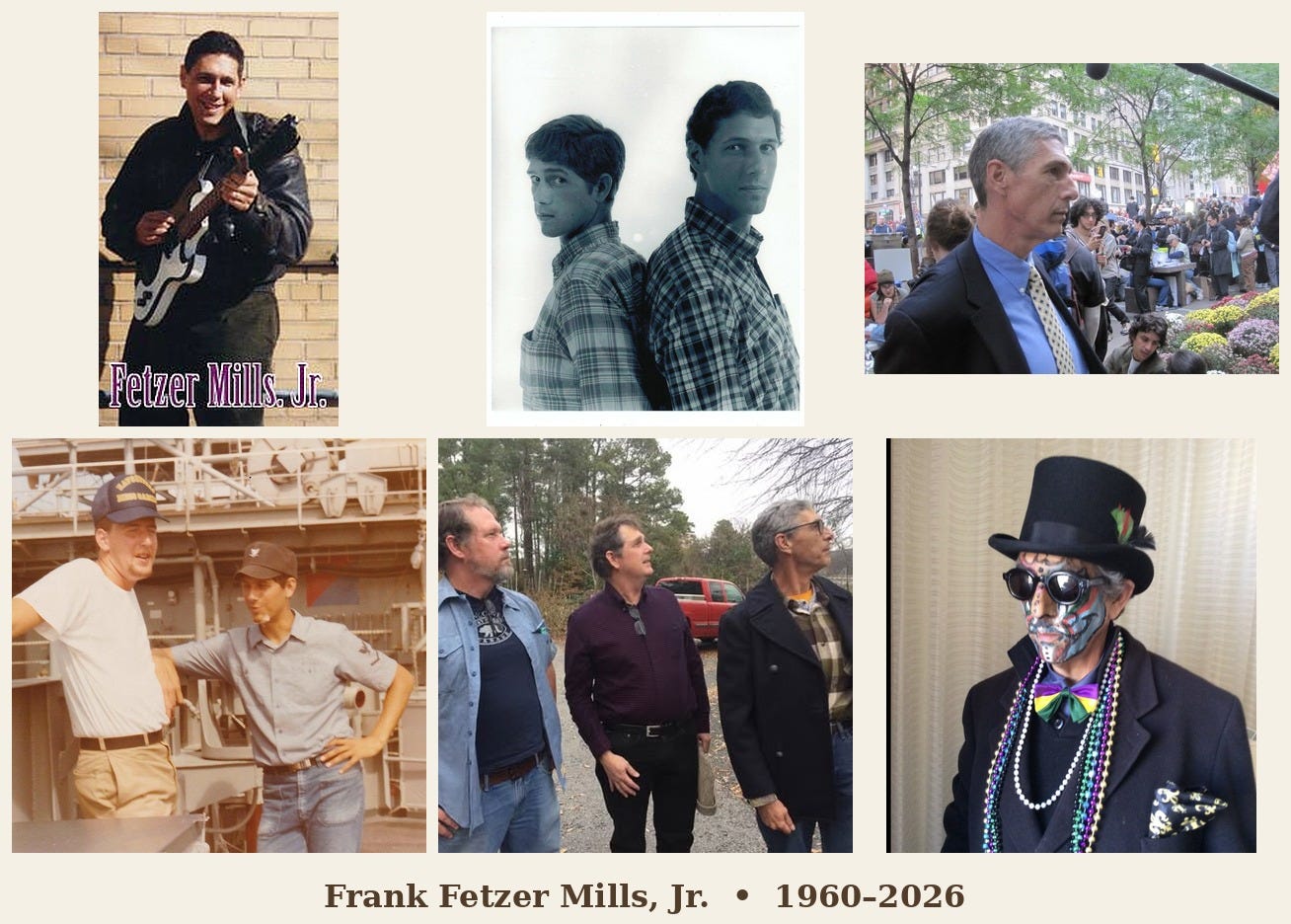
Frank Fetzer Mills, Jr. died July 5, 2026, from complications related to Wilson’s Disease. His wife, Becky, was with him as she has been throughout his long struggle.
Fetzer lived life on his own terms, often doing what so many others only wished they could do. He never had a traditional career, but he was always doing something interesting. At various times, he was a writer, journalist, political consultant, tour manager, teacher, music producer, actor, documentary filmmaker, and security guard, among other things. He threw himself into his interests and often found himself enmeshed with his subjects. The writer Hal Crowther described him as “versatile.”
Fetzer was born in Chapel Hill, North Carolina, on August 7, 1960, but he grew up in Wadesboro, NC. He was the oldest of four sons of Fetzer and Penny Mills. By all accounts, he had a happy childhood at a time when small towns were still thriving and cohesive communities.
He learned to read early and devoured books for the rest of his life. He graduated from Bowman High School in 1978 and then joined the Navy. He was recognized for his work as an Arab linguist and was stationed in Rota, Spain, for much of his enlistment. He was extremely proud of his service to his country and stayed in touch with a network of fellow veterans throughout his life.
After four years in the Navy, he enrolled at the University of North Carolina at Chapel Hill. His college years kicked off a decade of creative energy. While in school, he took classes that ranged from political science to art. He ran for student body president. He acted in plays. He wrote short stories. Fetzer joined the Chi Psi fraternity at a time when it was turning out a combination of political leaders and artistic innovators.
In an earlier era, Fetzer would have been considered a BMOC, or Big Man on Campus. In the 1980s, he was a big personality who was well known throughout the University community. He was awarded both the Order of the Old Well and the Order of the Golden Fleece for his accomplishments as a student leader.
After college, he spent a few years working on political campaigns and covering them as a reporter for several news outlets. He was the legislative reporter for Freedom Newspapers, a chain of mid-sized dailies across the state, and the political reporter for the alternative weekly Spectator Magazine, where his writings leaned toward Gonzo journalism. He would continue to publish as a freelance writer for the rest of his life.
While covering the 1988 presidential hopefuls at a forum in Chapel Hill, Fetzer asked them which article of the Constitution establishes the executive branch. Only Al Gore could answer the question. Fetzer was unimpressed, comparing Illinois Senator Paul Simon to a character out of Revenge of the Nerds, bemoaning Tipper Gore’s “crackpot crusade against rock and roll,” and declaring eventual nominee Michael Dukakis “as bland and boring as he is stable and competent.” He recommended Democrats nominate the Godfather of Soul, James Brown, with the slogan “Get down with Brown.”
Fetzer wrote the definitive narrative of the 1989 House coup in the North Carolina legislature for Leader Magazine. A handful of rebellious Democrats joined with Republicans to oust Speaker Liston Ramsey, widely regarded as the most powerful man in Raleigh, and elect fellow Democrat Joe Mavretic. His blow-by-blow account still reads like a political thriller.
Music was an important part of Fetzer’s life and he was drawn to roots music like bluegrass, the blues, and rockabilly. He briefly served as tour manager for the Flat Duo Jets, the influential Chapel Hill band, and helped promote Southern Culture on the Skids.
In 1988, Fetzer met Becky. It was love at first sight — two quirky humans who were up for life’s adventures. They married in 1989 on top of a mountain and initially settled in Hillsborough, NC, where Becky practiced law. Fetzer fell in with a group of prominent writers and artists who inhabited the town.
During that period, he published a short story called “Hexema, Hexema” about a young woman whose husband got killed in a septic tank accident. It was laugh-out-loud funny.
A few years later, Fetzer and Becky moved to Ripley, Tennessee, to be near Becky’s aging parents. They bought a condo in Memphis and the city became Fetzer’s new creative muse. He loved the music, the culture, and the river that flowed through it. He found himself right at home among the blues musicians, folk artists, and aging rockabilly heroes who gave the city its character.
Early in their marriage, Becky took Fetzer to Graceland, Elvis Presley’s mansion on the edge of town. When their tour group reached the Memorial Garden where Elvis is buried, Fetzer got into an argument over whether the King was dead or not. Fetzer took the alive side, claiming to have seen Elvis buying a shotgun at the Walmart in Wadesboro. It caused quite a stir. Becky was thoroughly embarrassed and Fetzer was thoroughly pleased with himself.
Later, Fetzer went to work at Graceland, where he befriended Vester Presley, the last living relative of Elvis to live on the grounds. In his book I, Elvis, Confessions of a Counterfeit King, Bill Henderson describes Fetzer’s time at Graceland.
Fetzer blended into the Memphis music scene seamlessly. At one point, he recorded two songs at Sun Studio with rockabilly legends Roland Janes and Malcolm Yelvington backing him up. Later, he became friends with Sam Phillips, the original owner of Sun and the man who discovered Elvis.
By the mid-1990s, Fetzer was plagued by a myriad of illnesses that slowed him down and landed him in the hospital on several occasions. He was finally diagnosed with Wilson’s Disease, a genetic disorder that causes copper to build up in soft tissue, destroying or damaging organs including the liver, kidneys, and brain.
Despite struggling with his disease, Fetzer remained productive. He received a master’s degree in Southern Studies from Ole Miss. He produced a documentary about the fight for voting rights in west Tennessee. When three hurricanes hit North Carolina in the late 1990s, Fetzer published a series of articles documenting the environmental impact on eastern North Carolina. He also produced records for recording artists in Memphis and Taos, New Mexico.
In Ripley, Fetzer organized a street fair called the Tomato Festival. He used his Memphis connections to bring talented musicians to the small town and fought to ensure the entertainment was inclusive and diverse, reflecting the population of the community.
Fetzer taught creative writing at Dyersburg State Community College in west Tennessee. When he realized that most of his students did not have computers, he found a company that donated refurbished ones. He told his classes that if they could talk, they could write. Fetzer had a deep sense of compassion for people who need a hand up in life.
Fetzer attracted people and was well known wherever he lived. They were drawn to his eccentric sense of humor and stayed for his quick mind and firm convictions. He had strong opinions and the intellectual heft to back them up. He felt a kinship with those left behind by society and had an innate sense of justice. His friends came in all shapes and sizes, both figuratively and literally.
Fetzer loved to travel and saw much of the country and the world. He loved dogs and cats and always had a bunch of them around him. He and Becky collected so much art that their homes were virtual art museums. Fetzer always said he had a great life and would not have changed a thing, despite his often exhausting fight with Wilson’s Disease.
He is survived by his wife Becky, his mother Penny, his brothers Thomas and Smithson (Kathy), three nieces, two nephews, and four cats. He was predeceased by his father, Fetzer Sr., and his brother Eddie.
You did him proud Thomas!
What a beautiful and perfect testament to the life that Fetzer lived on his own terms. I remember so well growing up and watching him and my brother, Marshall, and the rest of you Mills boys and a lot of other Wadesboro boys run around, often getting into minor predicaments. I’m so sorry the world has lost Fetzer, Thomas. May you find a lot of comfort in knowing he lived a good life. Hugs to Penny!