

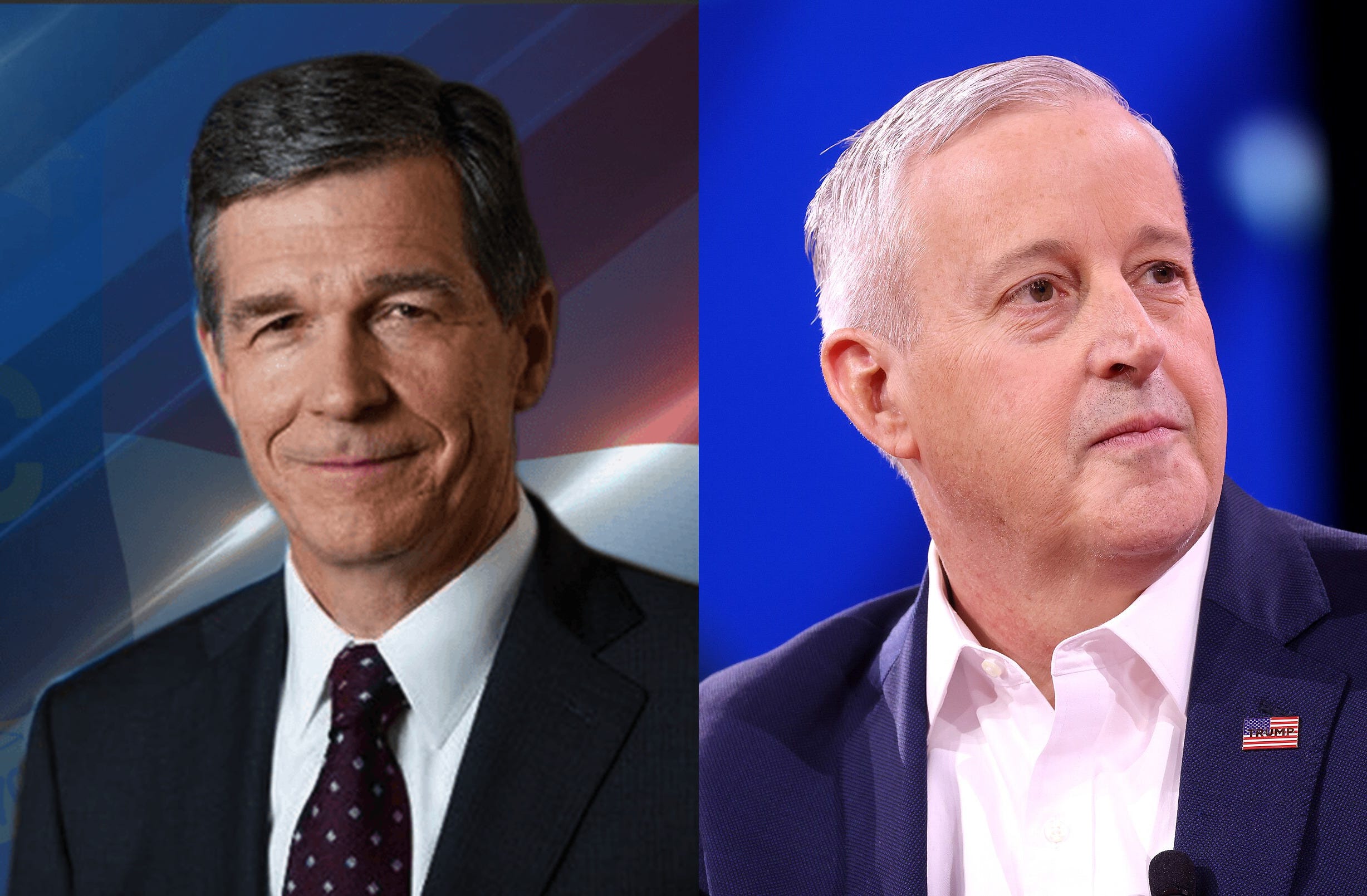
The election is three weeks from tomorrow. In North Carolina, some of the polls are starting to come back to earth. Roy Cooper is not going to win the state by double digits. The latest East Carolina University poll and one from Trafalgar released yesterday probably have more realistic assessments.
The ECU poll has Cooper up 50% to 43%, with 6% undecided. When the pollsters pushed undecided voters, they split evenly, with Cooper ahead 53% to 46%. That sounds much more plausible. I don’t really think any Democrat gets more than 53% of the vote, and I believe it could be less.
The Trafalgar poll shows Cooper leading by eight, 49% to 41%. They tested the third-party candidates, Shannon Bray and Michael Dublin, who get a combined 3.4% of the vote. Seven percent are undecided. None of these polls show Whatley with enough to catch up, but they do show Cooper with a cap just above 50%. As I’ve said before, the outcome of the Senate race will influence campaigns down-ballot.
Independent voters are breaking for Cooper by 16 points, according to the ECU poll. That’s probably decisive in an evenly divided state and bodes well for the court and legislative races. We aren’t likely to see a large percentage of those folks splitting their ballots.
The size of Cooper’s win will be determined by turnout among each party’s base. The Democratic base seems motivated, judging by steadily increasing registration numbers. They surpassed Republicans in voter registrations this week. While the numbers might not make a difference in an election with almost 4 million voters, they indicate an enthusiasm that hasn’t been seen in recent years.
Since early-August, Democrats have consistently outpaced Republicans in net voter registrations. Last week alone, Democrats gained more than six times as many as Republicans, 5,055 to 804, according to Andy Jackson of the John Locke Foundation. That may signal Democratic motivation. In the same stretch of the last midterm, the pattern ran the other way. In the week ending Oct. 8, 2022, Republicans outgained Democrats 1,460 to 921, and Ted Budd went on to defeat Cheri Beasley by about three points.
In 2018, the last really good election for Democrats, Republican turnout was about four points higher than Democratic turnout. The independents breaking for Democrats gave them the edge. For a wave to happen in North Carolina this year, Democrats need to match or surpass Republican turnout.
I think the polls will get a bit more realistic as we head down the stretch. In a state like North Carolina, it’s hard for either party to win by more than about three points. If Cooper gets beyond that, he will have coattails, and the bigger his margin, the longer they’ll be. With enthusiasm in their favor, Democrats need to push hard to motivate their base to drive up the score. They should have a good night in three weeks. They could make it a great one.

Trafalgar? Are you kidding. Notoriously Republican biased, if not deceptive.
The key races at this point are the Legislature. There is a decent shot to win the House, and conceivably even the Senate. We have to work hard.
Seven percent is the Half Stein I’ve been calling since the race started. While I’d LOVE to see a Full Stein, I think in order to win by 15% you have to be running against Mark Robinson.
Though Michelle Morrow might make a suitable substitute.🤣